
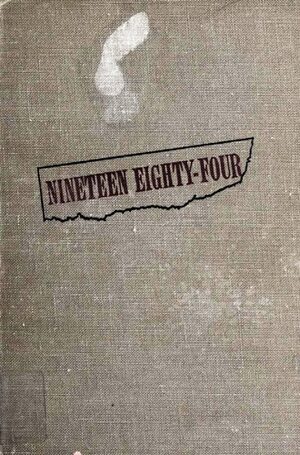
1984 book review: Nineteen Eighty-Four by George Orwell
Our verdict: is 1984 a good book?
Nineteen Eighty-Four is best suited for mature young adult readers who appreciate thought-provoking, slow-paced dystopian fiction. The story follows Winston Smith, a low-ranking clerk in a totalitarian state where surveillance and control permeate every aspect of life. The book unfolds with a deliberate, slow pacing and features closed door scenes regarding intimacy. It contains long torture sequences that serve as a main content warning. This standalone novel offers a chilling exploration of power and resistance without any sequels or series continuation.
Spice level, tropes and content warnings
Spice runs from 0, no sexual content, to 5, explicit and central to the plot. The rating is the site's overall score from 1 to 5 in half steps. Tropes and content warnings come from the book itself. See how Fiction Lists rates books.
- Spice
- 1 of 5, Closed door: kissing only; scenes cut away (closed door)
- Age group
- Young adult
- Content warnings
- torture, abuse, violence, sexual assault, addiction
- Rating
- 4 / 5
| Level | Label | Meaning |
|---|---|---|
| 0 | None | no sexual content |
| 1 | Closed door | kissing only; scenes cut away (closed door) |
| 2 | Low detail | one or two on-page scenes, low detail |
| 3 | Explicit | several explicit scenes; the plot carries the book |
| 4 | Frequent | explicit and frequent |
| 5 | Central to the plot | explicit, frequent and central to the plot |
Who it is for: the 1984 book age rating and the 1984 book reading level
On the site's scale, the novel falls into the category of young adult. Similarly, Common Sense Media assigns it an editorial age of 16+. The young adult classification fits because the prose remains straightforward, relying on short declarative sentences and everyday vocabulary. What raises the recommended age, however, is the late-book torture, which is the content warning most frequently cited in discussions of the novel. It is a common assignment during the final years of high school.
What to know before reading 1984: the hard scenes, the pace and the structure
The most intense scenes occur in Part Three, which depicts prolonged torture through beatings, starvation, sleep deprivation, and a pain machine. While these episodes contain little gore, readers should be prepared for an extended sequence of them late in the book. Violence appears in the form of rocket bomb strikes, a war newsreel showing the bombing of a refugee boat, and the public hangings of enemy prisoners. Readers should also expect pervasive substance use: characters constantly consume Victory Gin as their sole comfort, cigarettes are ubiquitous, and Winston drinks heavily. This reliance on gin represents the addiction warned about on this page.
Part One moves at a slow pace, building the world with almost no plot events: the diary, the Two Minutes Hate, a daily ritual of screamed hatred at the telescreen, a walk through the prole district and the junk shop. Part Two holds the affair, and its chapter 9 is a long extract from a banned political book that reads like a political essay. While a minority call it the best part of the novel, many readers name it as the point where the book stalls. The pace quickens dramatically in Part Three, which many readers credit with making the book a classic. Finally, the appendix, "The Principles of Newspeak," is a brief essay on the invented language.
Why was the book 1984 banned and challenged?
Challenged in US schools and libraries since the 1950s, the novel was also banned in the Soviet Union until 1988. In a notable 1981 US case in Jackson County, Florida, challengers objected to the book's sexual content and labeled it pro-communist. Conversely, other challenges originated from the opposite end of the political spectrum, interpreting the work as an attack on their own government. Both sides objected because the novel condemns any one-party state. Ultimately, because nothing in the text is explicit by modern standards, these challenges reveal far more about the eras in which they occurred than about the book itself.
The 1984 book themes
The novel's central theme is the state's total control over the individual, achieved through pervasive surveillance, the manipulation of language, and the rewriting of history. Telescreens installed in every Party member's home and workplace both broadcast and monitor citizens, and posters declare, "BIG BROTHER IS WATCHING YOU." History is controlled by altering records, encapsulated by the famous maxim: "Who controls the past controls the future." Meanwhile, thought is constrained through language, including concepts such as Newspeak, doublethink, thoughtcrime, and crimestop. Many of these terms, along with "Orwellian," "memory hole," "unperson," and "Thought Police," have since become part of everyday English.
How long is 1984 book: pages, genre and other facts
- Author
- George Orwell
- First published
- 1949
- Pages
- 304
- Genre
- Science fiction
- Age group
- Young adult
- Series
- Standalone
- ISBN-13
- 9781328869333
- Updated
- 2026-09-11
Questions about the 1984 book
What age is 1984 appropriate for?
Common Sense Media’s editorial team recommends the book for ages 16 and up, an assessment we agree with. While both parents and teens on that site suggest an age of 14+, reader opinions gathered for this page also place the reading age at 16 and above.
Why was the book 1984 banned?
The Soviet Union banned the book until the year 1988, yet readers behind the Iron Curtain who obtained a copy of the book noted that it described their lives with striking accuracy.
Who is Big Brother in the 1984 book?
As the figurehead of the Party, Big Brother appears on every poster as a man of about forty-five with a black moustache. Every success is credited to him, while every failure is blamed on Goldstein. Beneath him, society is divided into the Inner Party, the Outer Party, and the politically excluded working-class majority known as the proles, while the Thought Police watch for disloyalty.
Who are the 1984 book characters?
Thirty-nine-year-old Winston Smith rewrites old newspaper articles in the Records Department of the Ministry of Truth. Julia, twenty-six, maintains novel-writing machines in the Fiction Department and wears the red sash of the Junior Anti-Sex League. Winston's neighbour, Parsons, is a devoted follower whose children are trained to spy on adults, and his colleague Syme works diligently on compiling the Newspeak dictionary. Goldstein is the official Enemy of the People.
What are the 1984 book themes?
The main themes center on state control of the individual, pervasive surveillance, the rewriting of history, and the manipulation of thought through language. A fifth key theme is perpetual war, which is used to keep the populace impoverished and fearful under the Party's core slogans: "War is peace. Freedom is slavery. Ignorance is strength." Ultimately, reality control goes even further, granting the Party the power to dictate that 2 + 2 = 5.
How long is the 1984 book?
The edition used on this page is a 2017 paperback running 304 pages, which matches the count in the facts table below. Other editions range from about 248 to 368 pages. The book is divided into three parts followed by an appendix: Part One contains eight chapters, Part Two has ten, and Part Three has six.
What reading level is 1984?
Written in plain prose, the book is a common assignment for upper-level high school students. The Newspeak vocabulary is clarified within the text itself and again in the appendix. The real challenge lies in the complex ideas, the essay-like chapter in Part Two, and the bleak atmosphere, all of which younger readers should be prepared to navigate.
What is the book 1984 about?
Set in Airstrip One, formerly Britain and now a province of Oceania, the story follows a clerk living under total state surveillance whose job is to rewrite the past. Risking death or twenty-five years in a labour camp, he begins a secret diary and writes DOWN WITH BIG BROTHER. He embarks on a forbidden love affair and searches for proof that resistance exists.